How Do Houston Towing Companies Legally Handle a Vehicle With Expired Registration on Private Property?
An expired registration sticker does not automatically give you the right to tow a vehicle from your Houston property — but under the right circumstances and with the right documentation, it can be a lawful enforcement trigger. The distinction matters enormously. Property managers across Harris County who call a non-compliant towing company to remove an expired-registration vehicle without following the correct statutory process can face personal liability, wrongful tow complaints filed with the Texas Department of Licensing and Regulation (TDLR), and civil exposure from vehicle owners. This article breaks down exactly how a licensed, compliant towing company handles this situation and what you need to have in place before that call is ever made.
What Texas Law Actually Says About Expired Registration on Private Property
Texas Occupations Code Chapter 2308 governs private property towing in this state. It does not list expired registration as a standalone tow-authorization trigger the way blocking a fire lane or parking in a reserved space does. Instead, the legal pathway for removing a vehicle with expired registration from private property typically runs through one of two routes: a consent tow authorized by the property owner or manager under §2308.255, or an abandoned vehicle removal governed by Texas Transportation Code §683.002.
Understanding which route applies to your situation is the first thing a compliant towing partner should walk you through — not something you should have to figure out on your own.
Route 1: Owner-Authorized Consent Tow Under §2308.255
If your lease agreement, HOA covenants, or property rules specifically prohibit vehicles with expired registration from being parked on the property, and your signage is compliant with §2308.301 and §2308.302, then you may have grounds for a consent tow. Texas Occ. Code §2308.255 requires that authorization for a private property tow be provided in writing. That written authorization must describe the vehicle being towed and confirm the authorizing party has the legal right to authorize removal.
Your signage must be posted at each entrance to the property, meet minimum size requirements, and clearly state the conditions under which vehicles may be towed — including, if applicable, expired registration. If your signs do not reference that specific enforcement condition, your towing company cannot lawfully use it as the basis for removal. This is one of the most common compliance gaps we see at properties across the I-10 corridor and the FM 1960 area.
Route 2: Abandoned Vehicle Removal Under Texas Transp. Code §683.002
A vehicle with significantly expired registration — particularly one that appears unmoved over an extended period — may qualify as an abandoned vehicle under Texas Transportation Code §683.002. Under this statute, a vehicle left on private property for more than 48 hours without the property owner’s consent may be reported as abandoned. Expired registration, combined with visible signs of disuse (flat tires, accumulated debris, no movement), strengthens the abandoned vehicle classification.
This route requires specific documentation: a written record of when the vehicle was first observed, photographs showing its condition and location, and proper notification procedures before removal. A TDLR-licensed towing company operating under this authority must also notify law enforcement and report the tow within the required timeframe. If you are managing a large apartment community in Cypress or Spring where vehicle abandonment is a recurring issue, this statutory framework is the one you need to understand cold.
For a full breakdown of the abandoned vehicle process, see our guide on abandoned vehicle towing in Houston.
The Compliance Gap Most Houston Property Managers Don’t Know About
Here is what competitor towing companies in Houston rarely explain and what we consistently find missing from how other operators handle expired-registration vehicles: the condition of your written towing authorization agreement matters as much as the condition of the vehicle.
Under §2308.255, a towing company operating on private property must have a written agreement with the property owner or manager on file. That agreement must specify the basis on which vehicles may be towed. If your contract with your current towing company is generic — or worse, verbal — and does not specifically identify expired registration as an enforcement condition, you are not protected if the vehicle owner files a complaint with TDLR or pursues a wrongful tow claim in Justice of the Peace court.
This matters especially for HOA boards in communities like Katy and Sugar Land, where residents are dues-paying members with enforceable rights under deed restrictions. Removing a neighbor’s vehicle for expired tags without airtight documentation is the kind of situation that turns into a board meeting dispute and, in some cases, a lawsuit.
What Your Signage Must Say Before You Enforce for Expired Registration
Texas Occ. Code §2308.301 and §2308.302 set out the signage requirements for private property towing enforcement. To legally enforce expired registration as a tow condition, your posted signs must:
- State that vehicles with expired registration are subject to towing at the owner’s expense
- Be posted at each entrance the public might use to access the property
- Meet minimum dimension requirements specified by TDLR rules
- Include the name and telephone number of the towing company authorized to remove vehicles
- Be permanently installed — not taped, laminated sheets stapled to a post
If your signs do not check every one of those boxes, your enforcement action on expired registration vehicles is legally vulnerable. A compliant towing partner should offer to conduct a signage review of your property before enforcement begins — not after a complaint has already been filed.
How a TDLR-Licensed Towing Company Handles the Actual Removal
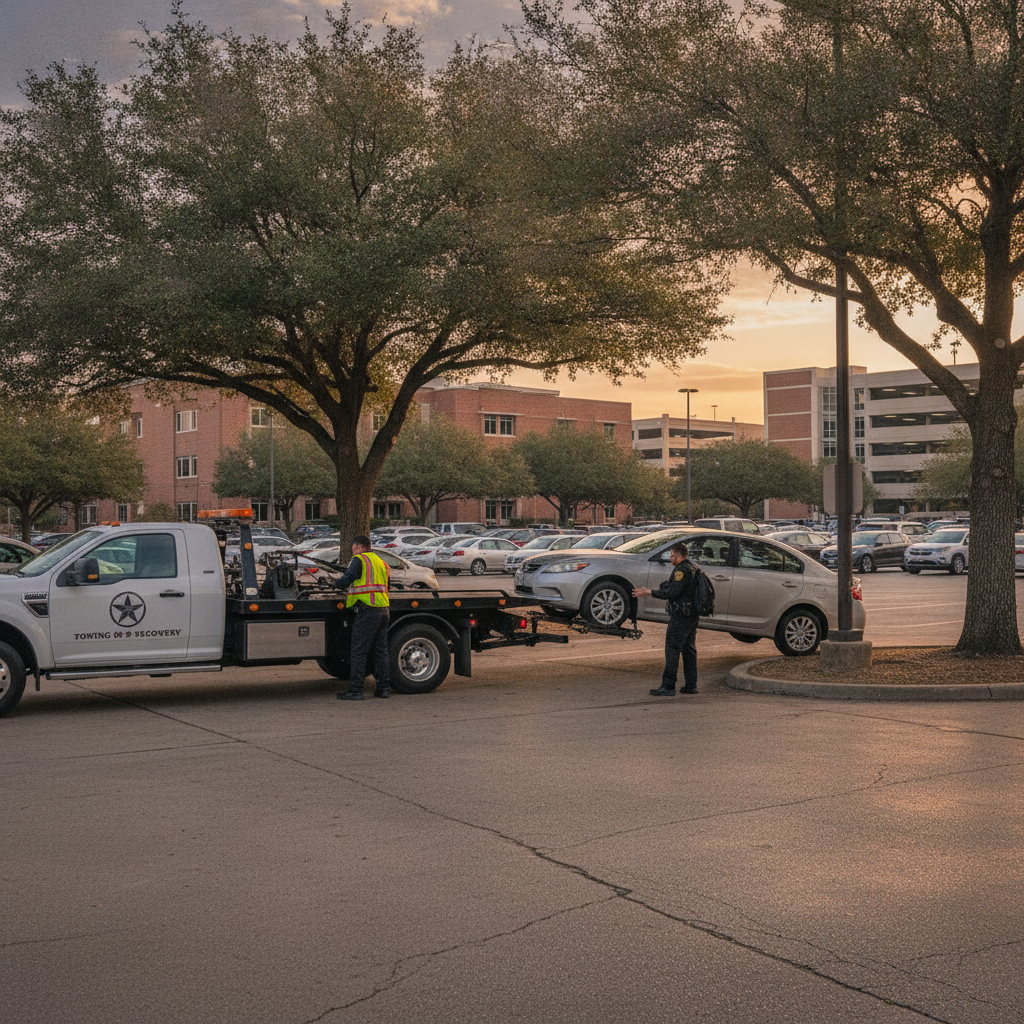
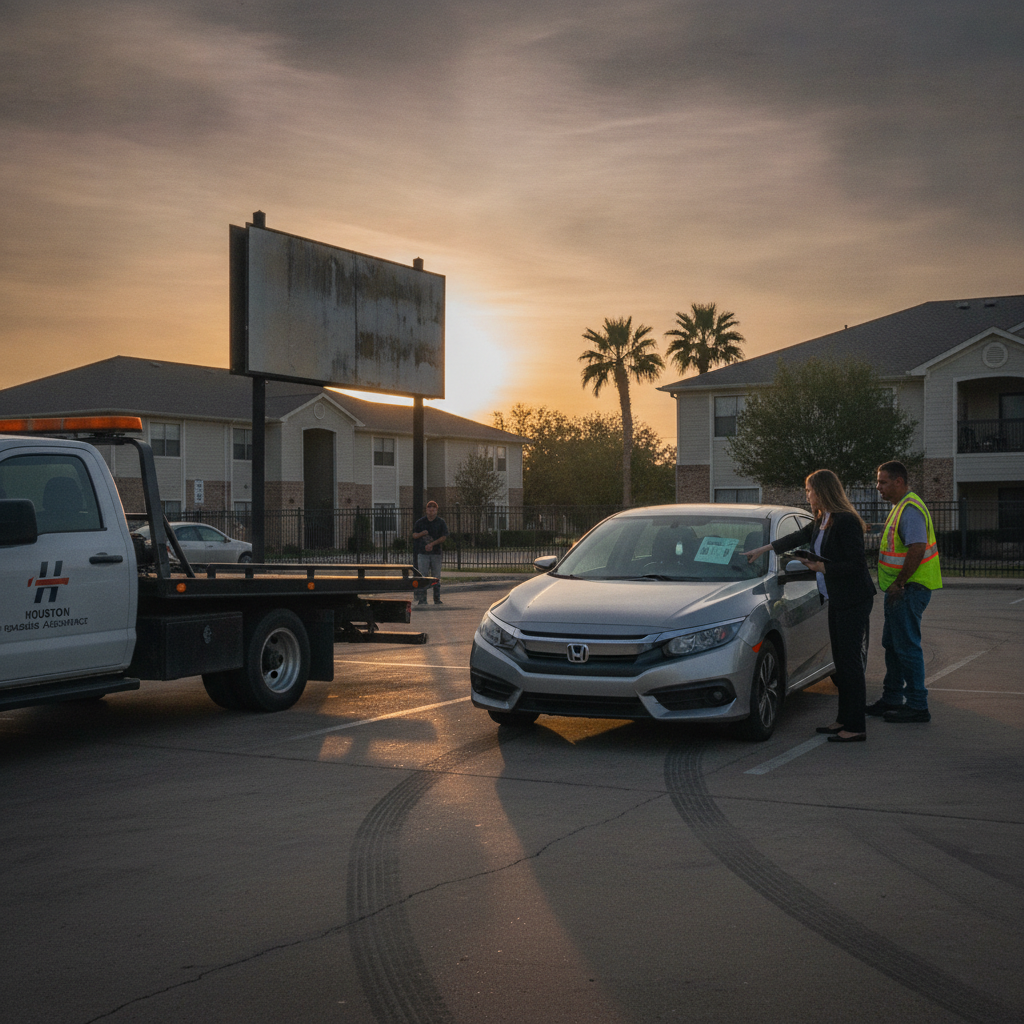
Once the legal basis for removal is confirmed, a compliant towing operator follows a specific process for expired-registration vehicles. This includes photographing the registration sticker, the vehicle’s position on the property, and any posted signage visible from the vehicle’s location. The operator documents the written authorization from the property manager, records the vehicle’s VIN and plate information, and notifies the appropriate law enforcement agency as required by §2308.451.
The vehicle owner must then be notified of the tow through the required channels — typically via the TDLR’s towing database and through the storage facility where the vehicle is held. Storage fees begin accruing from the time of removal. The owner has the right to request a hearing before a Justice of the Peace under §2308.456 if they believe the tow was unlawful. That hearing process is exactly why documentation discipline at every step is non-negotiable.
If you manage a commercial property — a multi-tenant office park, a retail strip center, or a parking structure in the greater Houston metro — our parking enforcement and property solutions overview explains how we structure compliant enforcement programs for exactly these situations.
Why Cheap or Unlicensed Towing Companies Create Liability for You
Houston has no shortage of towing operators willing to remove any vehicle you point at, no questions asked, for a low per-tow price. The problem is that the liability for a wrongful tow does not rest solely on the towing company — it can attach to the property owner or manager who authorized it. Under Texas law, an improperly authorized tow can result in the vehicle owner recovering the cost of the tow, storage fees, and additional damages in JP court. If the towing company you used is unlicensed or operating outside TDLR compliance, your exposure increases significantly because you cannot point to a documented authorization chain that holds up to scrutiny.
This is particularly relevant in rapidly growing communities along the Highway 290 corridor and in Montgomery County, where new apartment developments and HOA-governed subdivisions are coming online faster than property managers can vet their service vendors. Taking the time to confirm TDLR licensure, a valid written enforcement agreement, and a documented process before the first tow happens is the only way to enforce with confidence.
Frequently Asked Questions
Can a Houston property manager tow a vehicle just because its registration is expired?
Not automatically. You need either a lease or property rule that prohibits expired-registration vehicles, compliant signage that references that enforcement condition, and a written authorization agreement with a licensed towing company under Texas Occ. Code §2308.255 — or the vehicle must qualify as abandoned under Texas Transp. Code §683.002 after sitting unmoved for more than 48 hours.
Does expired registration automatically make a vehicle abandoned in Texas?
No. Expiration alone does not create abandoned vehicle status. The 48-hour unmoved threshold under §683.002 is the governing factor, though expired registration combined with evidence of extended disuse strengthens the case. Documentation of when the vehicle was first observed is essential.
What if an HOA in Katy wants to enforce against expired-registration vehicles in a common area?
The HOA’s deed restrictions or community rules must specifically prohibit expired-registration vehicles from common area parking. Signage compliant with §2308.301 and §2308.302 must be posted, and the HOA must have a written enforcement agreement on file with a TDLR-licensed towing company. Without all three elements, the tow is legally exposed.
How long does the vehicle owner have to retrieve their vehicle after it has been towed for expired registration?
There is no Texas-mandated hard deadline for retrieval, but storage fees accrue daily from the time of removal. If the vehicle is never retrieved, the storage facility may pursue a lien sale after following proper notification procedures under Texas Transp. Code Chapter 683. The vehicle owner also has the right to request a JP court hearing under §2308.456 within a statutory timeframe.
Can a towing company in Spring or Cypress tow a vehicle for expired registration without contacting the property manager first?
No. A non-consent tow on private property based on expired registration requires either prior written authorization from the property owner or manager under §2308.255, or law enforcement involvement in an abandoned vehicle situation. A towing company that removes vehicles from your property without your authorization or without a properly documented enforcement agreement is operating outside the law — and your property could be named in the resulting complaint.
Work With a Towing Partner Who Gets the Legal Details Right
Expired registration enforcement is a narrow but frequently mishandled area of private property towing law in Houston. The difference between a clean, defensible tow and a wrongful tow complaint filed with TDLR often comes down to whether your signage language, your written authorization, and your towing company’s documentation process all aligned correctly before the truck ever backed up to the vehicle.
MC Towing Inc works with apartment communities, HOA boards, commercial landlords, and property managers across Harris County, Fort Bend County, and Montgomery County to build enforcement programs that hold up — not just on the first tow, but on every tow. We offer free property reviews to assess your current signage compliance, authorization documentation, and enforcement policy gaps before they become liability issues.
Contact MC Towing Inc at 713-222-2277 or reach us through our contact page to schedule your free consultation. We will review your property, your current towing agreement, and your signage to tell you exactly where you stand — before the next expired-registration complaint lands on your desk.