How Do Houston Gas Station and Convenience Store Owners Legally Enforce Parking and Towing for Non-Customer Vehicles?
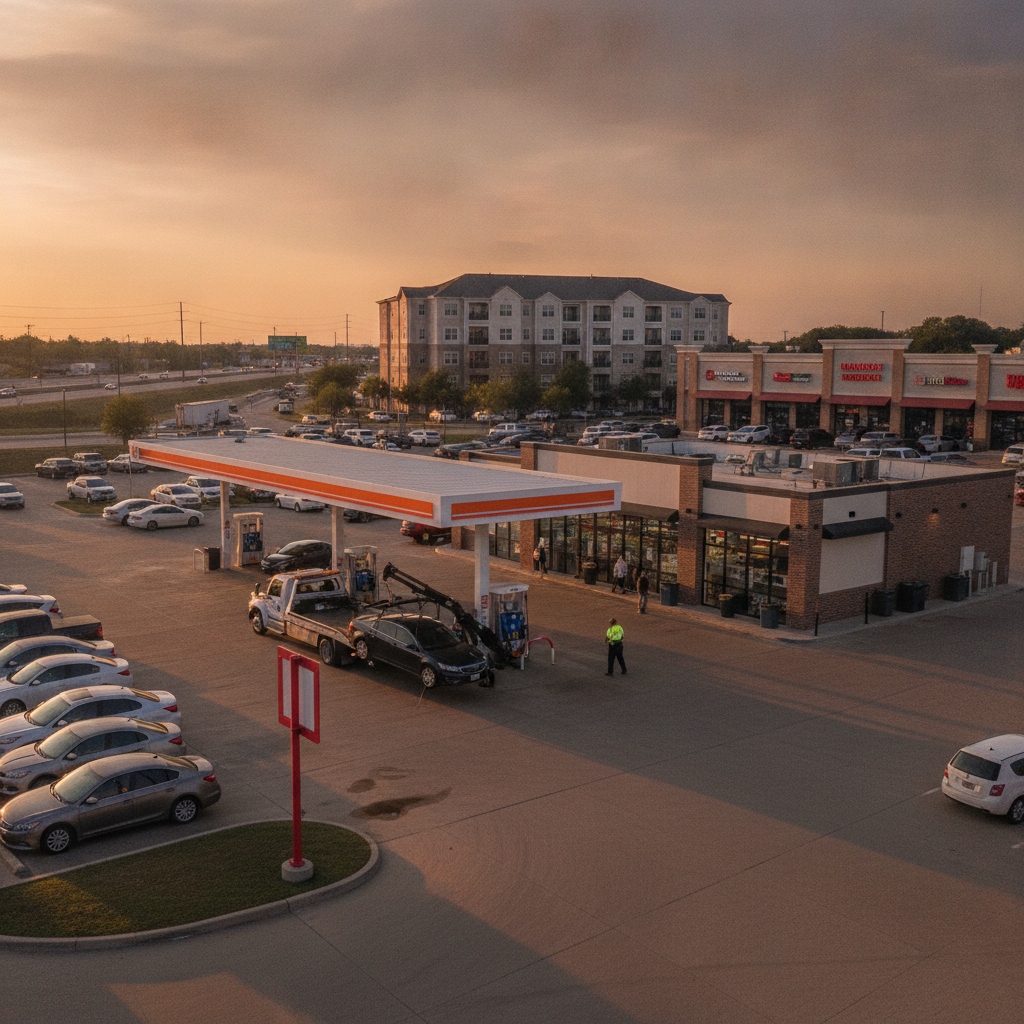
If you own or manage a gas station or convenience store in Houston, you already know the problem: your eight to twelve parking spaces exist for customers buying fuel or grabbing a quick purchase — not for commuters catching a carpool on I-45 North, employees from the office park next door, or overnight loiterers blocking your pumps. The good news is that Texas law gives you the authority to tow non-customer vehicles from your private property. The bad news is that the legal steps are specific, and skipping any one of them exposes you to liability. Here is exactly what you need to know.
Why Gas Stations Face a Uniquely Difficult Parking Enforcement Problem
Most retail properties deal with after-hours parking abuse. Gas stations and convenience stores deal with it around the clock. Your lot is open 24 hours, brightly lit, and positioned near major thoroughfares — which makes it a magnet for park-and-ride abuse, long-term vehicle storage, and unauthorized overnight parking in ways that a closed strip center simply does not experience.
Along the Highway 290 corridor, Beltway 8, and near major transit hubs in Pasadena and Baytown, fuel retail operators consistently lose pump-adjacent spaces to commuters who treat the lot as a free Park & Ride facility. That is lost revenue, reduced customer throughput, and in some cases a genuine safety problem when emergency access to pumps becomes obstructed. Enforcement is not optional — it is a business necessity.
What Texas Law Actually Requires Before You Can Legally Tow a Non-Customer Vehicle
Texas Occupations Code Chapter 2308 governs private property towing statewide, and it applies to your gas station lot the same way it applies to an apartment complex or an office park. There is no exemption for fuel retail properties, and that is something many Houston c-store owners do not realize until they are named in a wrongful tow complaint.
Compliant Signage Is Non-Negotiable
Under Texas Occ. Code §2308.301 and §2308.302, your property must display towing signs that meet specific requirements before any vehicle can be legally removed. Those requirements include:
- Minimum sign dimensions of 18 inches wide by 24 inches tall
- Lettering no smaller than two inches in height
- The name and telephone number of the towing company that will be used
- The hours during which unauthorized vehicles are subject to tow
- Signs must be posted at each entrance to the parking facility
- Signs must be visible from each parking space or, at minimum, clearly visible upon entering the lot
For a gas station with multiple driveways off a frontage road or a corner lot with two street-facing entrances, this means a sign at every access point — not just one sign on the building. A single non-compliant or missing entrance sign can invalidate an otherwise lawful tow.
Written Authorization From the Property Owner or Authorized Agent
Under Texas Occ. Code §2308.255, a towing company must have written authorization from you — the property owner or your authorized representative — before removing a vehicle from your lot. That authorization can be satisfied in two ways: either a signed towing authorization form for each individual tow, or a standing written contract with a licensed towing company that specifically grants the authority to enforce your lot on a continuing basis.
For a busy gas station where unauthorized parking can happen at any hour, a standing enforcement contract is the practical solution. It means your towing partner can respond and remove a vehicle without you having to sign off on each individual tow at 2 a.m.
Learn more about how private property towing contracts work in Houston and what your enforcement agreement should include to keep you compliant under Chapter 2308.
The Specific Risk That Most Houston C-Store Owners Overlook: Towing During Business Hours
Here is a gap that most towing industry content — including what you will find on competitor websites — completely fails to address for fuel retail operators: the legal and practical risks of towing during active business hours.
Many gas station owners assume that because the vehicle does not belong to a paying customer, they can have it removed at any time. That is largely correct under Chapter 2308, but it creates a practical complication specific to c-stores. If a customer parks, walks inside, and you have the vehicle towed before they return — even if they were only inside for five minutes — you now have an angry former customer, a potential dispute, and a towing company that will need to document why the vehicle was treated as unauthorized.
The cleanest approach for fuel retail operations is a clearly defined enforcement policy: vehicles parked beyond a posted time limit (commonly 30 to 60 minutes for c-stores), or vehicles parked in spaces not adjacent to your pumps or storefront during hours you specify, are subject to tow. Your signage must reflect those specific conditions. Your towing partner needs to understand and enforce those conditions consistently — not just remove every vehicle that has been sitting for more than ten minutes.
Overnight and Extended-Duration Parking: Where Enforcement Gets Cleaner
The clearest enforcement scenario for most Houston gas station owners is overnight or extended-duration parking — vehicles left for hours or days with no active transaction on your property. This is where park-and-ride abuse, vehicle storage, and in some cases abandoned vehicles become an issue.
If a vehicle has been on your lot for an extended period with no evidence of customer activity, it may qualify for removal under your private property towing authorization. If a vehicle shows signs of abandonment — missing plates, expired registration, mechanical damage — it may also fall under Texas Transportation Code §683.002, which governs abandoned vehicle removal with its own documentation and timeline requirements.
Do not conflate the two processes. A vehicle parked without authorization on private property is handled under Chapter 2308. A vehicle that meets the statutory definition of abandoned requires a separate documentation process under Chapter 683. A compliant towing partner will know which process applies and handle the paperwork accordingly.
See how MC Towing Inc handles abandoned vehicle removal on commercial properties across Houston and Harris County.
What to Look for in a Towing Partner for Fuel Retail Properties
Not every towing company that serves commercial lots in Houston is set up to handle the specific enforcement dynamics of a 24-hour fuel retail operation. When evaluating a towing partner, ask these questions directly:
- Are you licensed by the Texas Department of Licensing and Regulation (TDLR) as required under Chapter 2308?
- Do you provide a standing written enforcement contract that satisfies §2308.255 authorization requirements?
- Can you perform a compliant signage review of my property before we begin enforcement?
- How do you document each tow — photograph, timestamp, GPS data?
- Do you maintain an after-hours release process so a vehicle owner can recover their vehicle at any hour?
- What is your response time to my location in Spring, Katy, or central Houston at 3 a.m.?
A towing company that cannot answer these questions with specifics is not an enforcement partner — it is a liability waiting to happen. The documentation and audit trail requirements under Chapter 2308 exist precisely because disputes about private property tows are common, and a paper trail is your primary protection.
iStall Virtual Permits: Relevant for Multi-Pump or Multi-Business Fuel Stations
If your property includes a gas station combined with a fast food tenant, a car wash, or other co-located businesses — a common format in Pearland, along the I-10 corridor, and in newer developments across Harris County — managing parking authorization across multiple tenants and uses gets complicated quickly. Who is a valid customer? Which spaces are shared? Which are restricted?
Virtual permit management platforms like iStall can help you define and enforce those boundaries digitally, creating a documented record of which vehicles were authorized and when. This is particularly useful if your enforcement policy differs by time of day or by parking zone on a larger lot. Your towing partner should be able to integrate with that system so that enforcement decisions are based on documented authorization — not a judgment call made at 2 a.m.
Frequently Asked Questions
Can I tow a vehicle from my gas station lot without posting signs first?
No. Under Texas Occ. Code §2308.301 and §2308.302, compliant towing signs must be posted at each entrance to your property before any vehicle can be legally removed. A tow without proper signage exposes you and your towing company to liability and may require the vehicle to be returned at no charge to the owner.
What if a non-customer parks at my pump and walks to a nearby business?
A vehicle occupying a fuel pump space without actively fueling or transacting on your property is occupying your private property without authorization. With proper signage and a standing enforcement contract, you have the legal right to have that vehicle removed under Chapter 2308. Document the situation with photographs and timestamps before initiating the tow.
Do overnight parking rules differ from daytime rules at a 24-hour gas station?
Your enforcement policy and signage can specify the hours and conditions under which vehicles are subject to tow. For a 24-hour operation, you can enforce around the clock — but your signs must clearly state that unauthorized vehicles are subject to tow at any hour. If your signs only reference specific hours, enforcement outside those hours may not be valid.
A vehicle has been in my lot for three days with no activity. Is that an abandoned vehicle?
It may be. Under Texas Transportation Code §683.002, a vehicle left on private property without the owner’s consent for more than 48 hours can qualify as abandoned and be subject to removal under that statute’s documentation requirements. Contact a licensed towing company familiar with both Chapter 2308 and Chapter 683 to determine the correct process before initiating removal.
What happens if my towing company removes a vehicle incorrectly from my gas station lot?
If a tow is found to be non-compliant — wrong signage, missing authorization, improper documentation — the vehicle owner may have grounds to demand the vehicle’s return at no charge and may file a complaint with TDLR. The property owner can also face civil exposure depending on the circumstances. This is why documentation and a licensed towing partner are essential, not optional.
Ready to Get Your Gas Station or C-Store Lot Under Compliant Enforcement?
MC Towing Inc works with commercial property owners across Houston, Pasadena, Spring, Katy, Pearland, and surrounding Harris County to set up enforceable, Chapter 2308-compliant parking programs — including signage reviews, standing enforcement contracts, and documented tow procedures that protect you from liability. If your fuel retail property is losing spaces to non-customers, we can help you take them back legally.
Contact MC Towing Inc today to request a free property review and find out what compliant enforcement looks like for your specific lot layout and business hours.