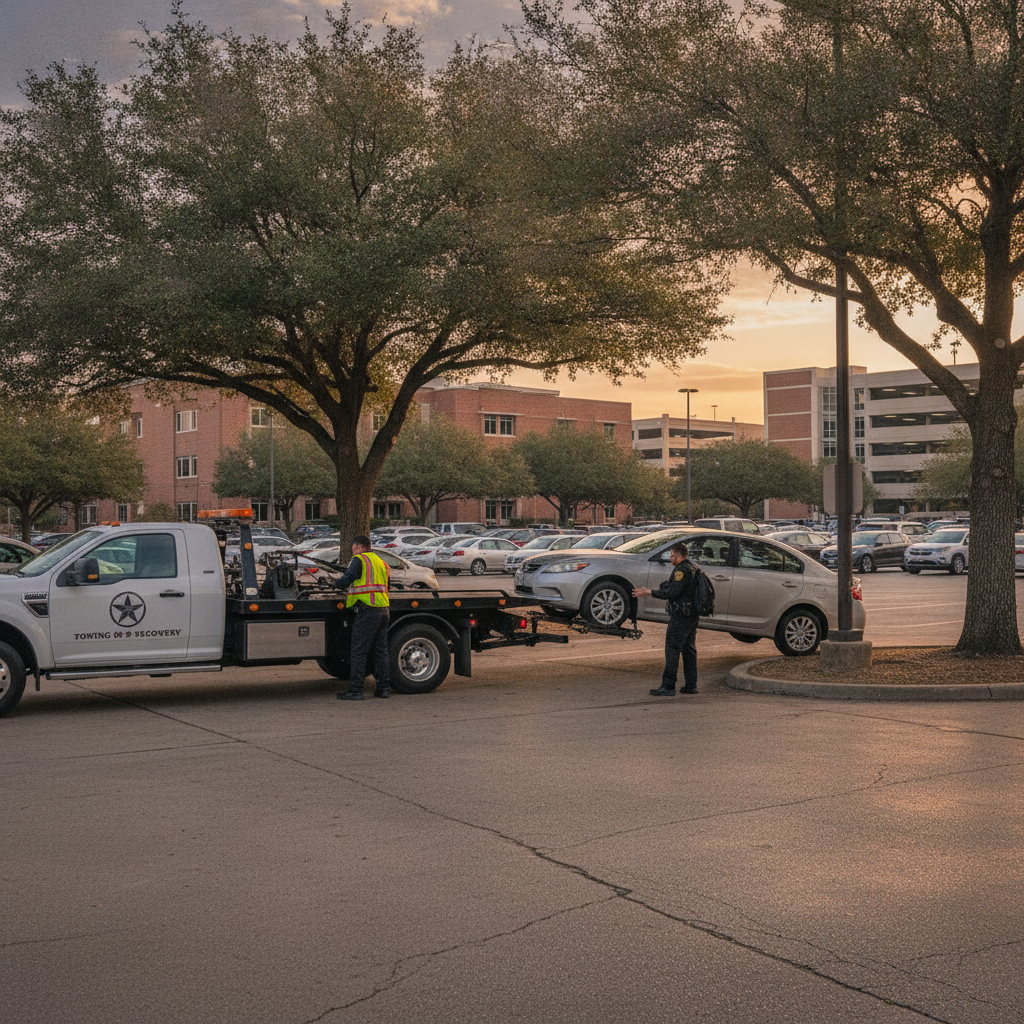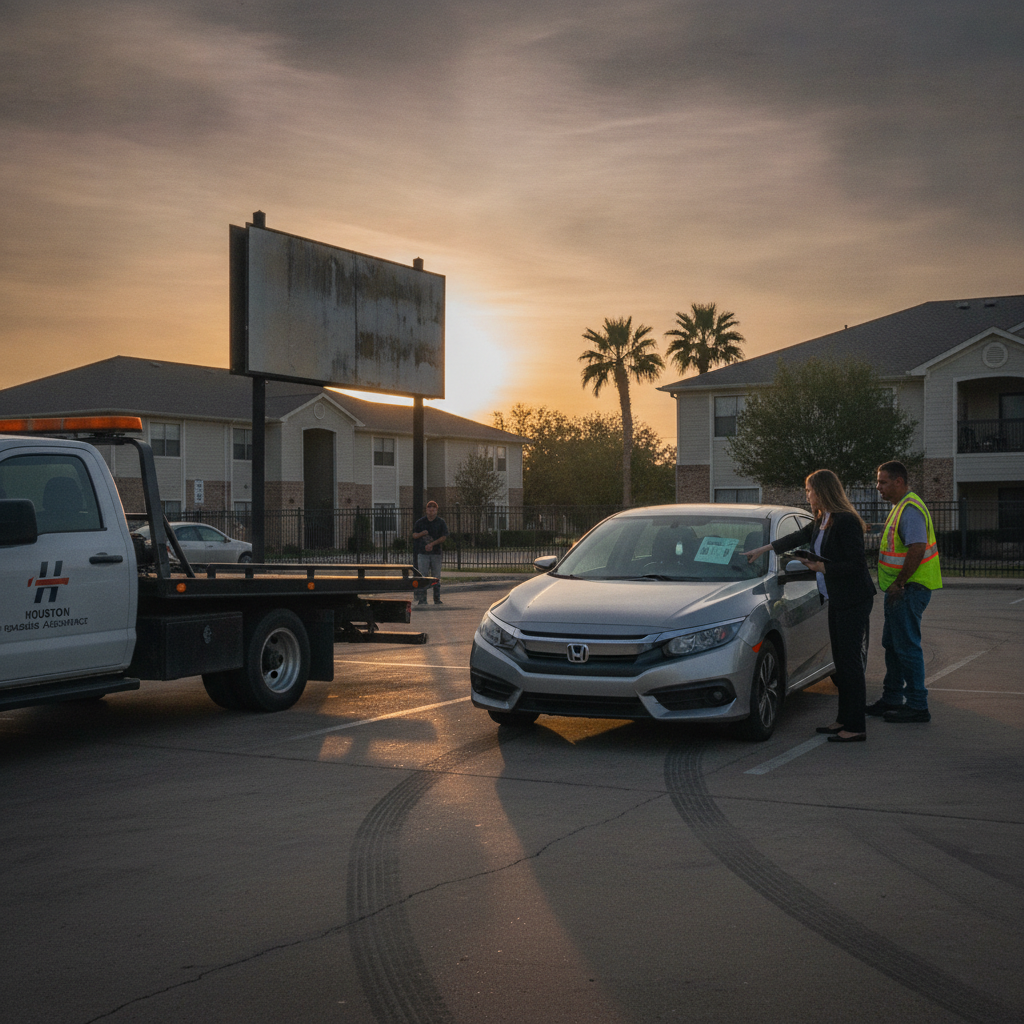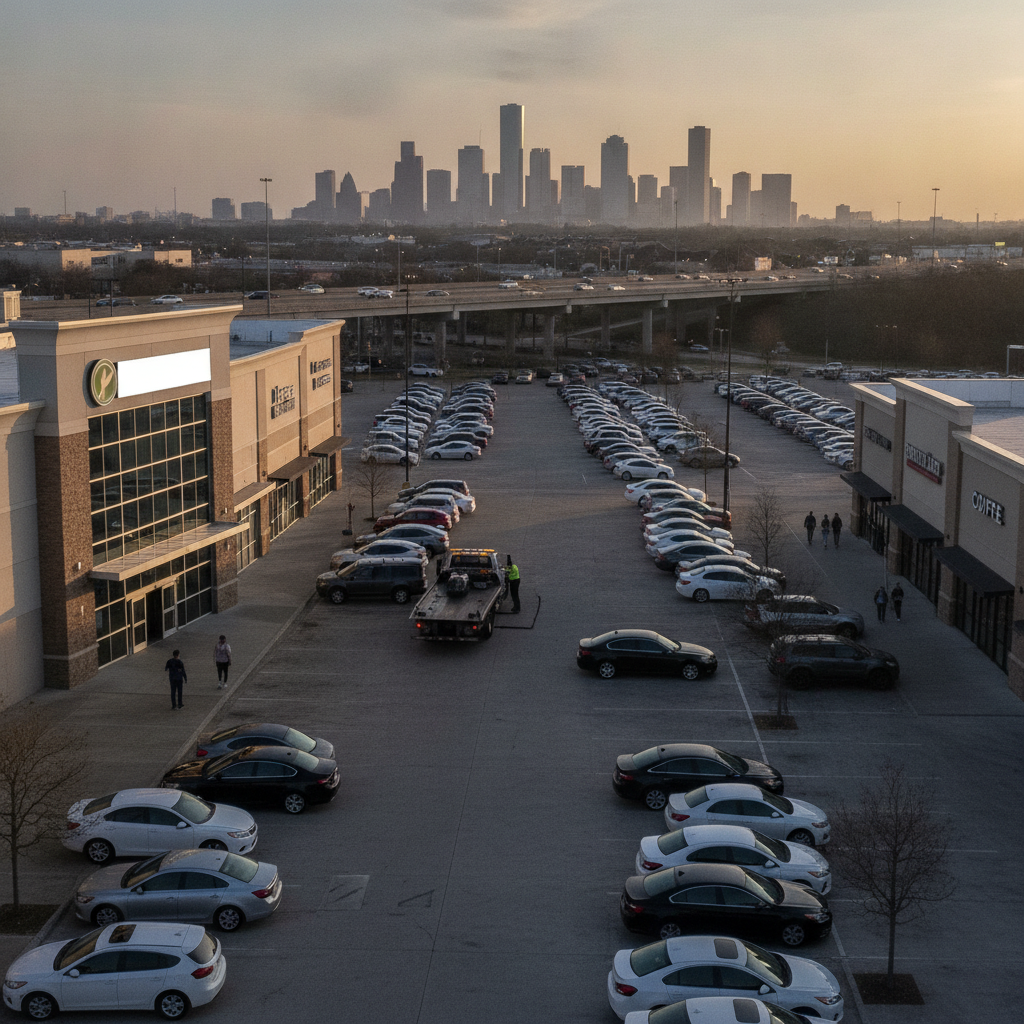
How Do Houston Industrial Park and Warehouse District Property Managers Legally Enforce Parking and Towing for Unauthorized Vehicles?
If you manage an industrial park or warehouse facility in Houston, unauthorized vehicles are not just a nuisance — they’re a direct operational liability. A personal vehicle parked across a loading dock at 4 a.m. can delay an entire inbound shipment. A truck cab idling overnight in a fire lane creates insurance exposure. And if you call a towing company that isn’t operating in strict compliance with Texas Occupations Code Chapter 2308, the enforcement action itself can become the legal problem. Here’s what you need to know to protect your property, your tenants, and your operations without cutting corners.
Why Industrial and Warehouse Properties Face a Different Enforcement Problem
Most parking enforcement guidance you’ll find online — and most competitor towing company websites — is written with apartment complexes or retail strip centers in mind. Industrial parks along the I-10 corridor, the Beltway 8 freight loop, and the heavy industrial clusters in Baytown, Pasadena, and Deer Park operate under a different set of real-world pressures.
Your tenants are running shift operations. Trucks are moving at all hours. Contractors, vendors, and freight drivers are cycling through constantly — and not all of them are authorized to park on your property between routes. Meanwhile, neighboring businesses, commuters using your lot as overflow parking, and in some cases vehicle abandonment tied to the high freight traffic on I-69 and I-45 North all create a parking environment that residential-focused enforcement programs simply aren’t built to handle.
Add the fact that many industrial properties in Harris County have multiple tenants sharing a common parking area, and you’ve got an authorization structure that has to be documented precisely before a single vehicle can be legally towed.
What Texas Law Requires Before You Can Tow Anyone
Texas Occupations Code §2308.255 is the starting point. Before any vehicle can be towed from your private property, you must have a written authorization from a person who is an owner or manager of the property. That sounds straightforward, but industrial and warehouse properties often have management layers — property management companies, asset managers, individual tenant leases — and the authorization chain has to be clean.
If your towing company accepts an authorization call from a tenant’s shift supervisor who has no documented authority over common parking areas, and that tow gets challenged, you are exposed. The statute requires that the individual authorizing the tow has actual authority over the property where the vehicle is parked. Document that chain of authority in writing before enforcement begins.
Signage compliance under §2308.301 and §2308.302 is equally non-negotiable. Every entrance used by vehicles must have a compliant sign posted at the correct height, with the correct font size, displaying the towing company’s name and phone number, fee schedule reference, and the specific prohibition language required by TDLR. Industrial properties with multiple ingress points — truck gates, employee entrances, visitor access roads — must have signage at each one. A single uncovered entrance can invalidate an otherwise compliant tow.
The Loading Dock Problem: What Counts as an Unauthorized Vehicle?
One of the most common questions from warehouse property managers is whether they can tow a vehicle that belongs to a current vendor or contractor who simply parked in the wrong place — specifically, a vehicle blocking an active loading dock. Under Chapter 2308, the vehicle doesn’t need to be entirely unknown to you. It needs to be parked in violation of a posted restriction or in a manner that your written enforcement authorization covers.
This is where the specificity of your signage and your towing contract matters. If your signage says “No Parking — Loading Zone — Violators Will Be Towed,” and that sign is posted at the dock entrance with compliant dimensions, a vendor’s personal vehicle parked in that zone can be legally removed. The fact that the vendor has a business relationship with one of your tenants is irrelevant to the towing authorization — what matters is whether the vehicle is in a restricted area with proper notice posted.
Work with a TDLR-licensed towing partner to review your signage placement across every dock bay, gate, and fire lane before you begin enforcement. MC Towing Inc offers compliant signage reviews as part of its parking enforcement and property solutions program — a step most industrial property managers skip until after their first disputed tow.
Overnight Truck Cab Parking: A Gap Most Towing Companies Ignore
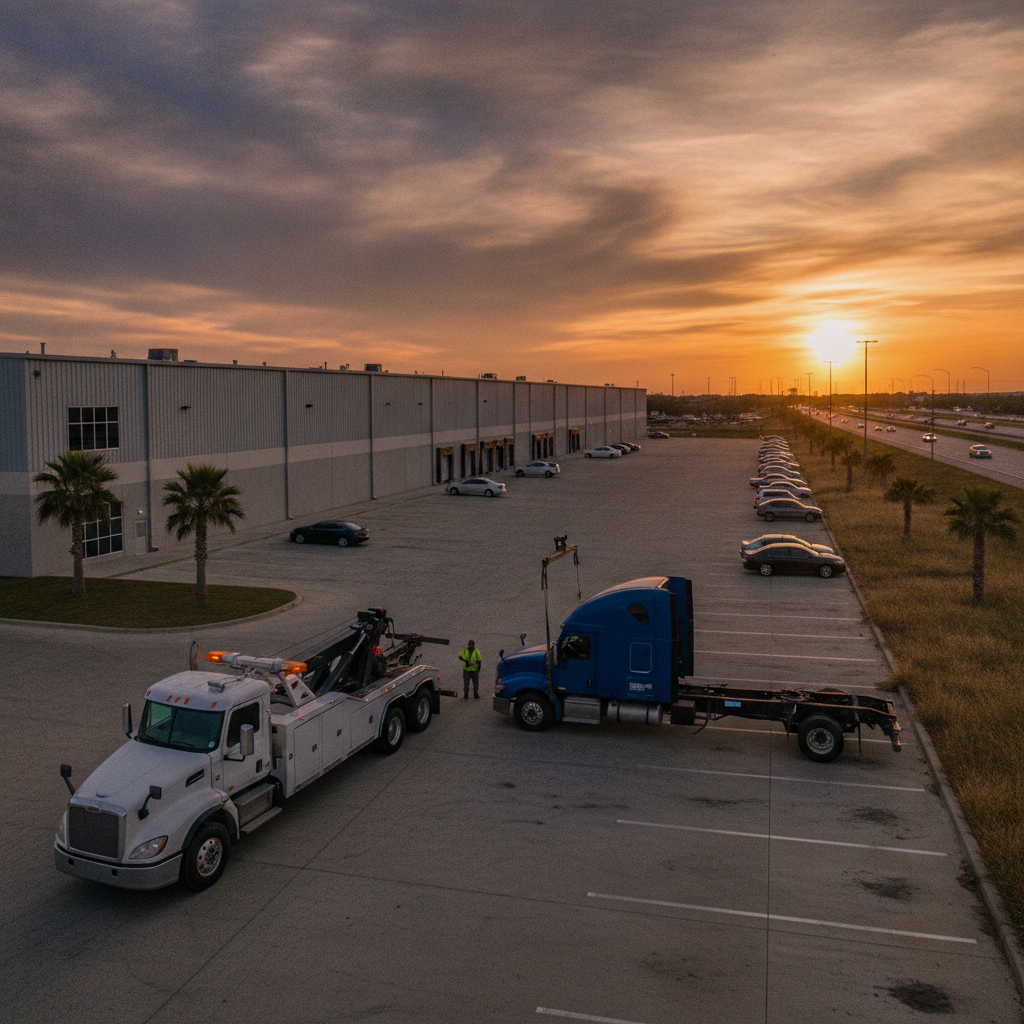
Here’s a topic that virtually none of the local competitor towing websites address: semi-truck cab parking on industrial private property. In freight corridors around North Houston, Greenspoint, and along Highway 290, owner-operators and regional carriers frequently leave cab-only trucks — no trailer — on industrial lots between routes. These are not abandoned vehicles in the traditional sense. They may belong to a driver who has a delivery at one of your tenants the following morning.
But from an enforcement standpoint, unless you have a written tenant authorization that explicitly permits guest or vendor overnight parking, and unless that authorization is reflected in your towing contract’s scope, an overnight cab sitting in your lot is an unauthorized vehicle. Texas Transp. Code §683.002 governs abandoned vehicles separately, and a cab that has been sitting for 48 hours or more without authorization may qualify for abandoned vehicle removal procedures — which carry their own documentation and notification requirements distinct from a standard private property tow.
If your property hosts tenants in logistics, distribution, or manufacturing, you need an enforcement program that specifically addresses how overnight commercial vehicle parking is handled — and one that your towing partner has documented protocols for. This is not something a generalist towing company running on a handshake agreement can manage correctly. Learn more about abandoned vehicle removal procedures under Texas law to understand where the line falls.
Multi-Tenant Properties: Who Has Authority to Call a Tow?
If you manage a multi-tenant industrial park in Katy, Spring, or the Pasadena ship channel area, your lease agreements should specify exactly which common areas are under the property manager’s exclusive enforcement authority versus which areas each tenant controls. This distinction matters legally.
Under §2308.255, each tenant can authorize tows from areas they exclusively control — their leased parking spaces, their private loading zones. But common driveways, shared truck courts, and visitor lots typically remain under the property manager’s authority. If a tenant calls a tow from a shared area without your authorization, and the tow company accepts that call, you may have a compliance problem on your hands even if the vehicle genuinely had no business being there.
The solution is a written enforcement policy that each tenant signs at lease inception, clearly mapping which spaces each party can authorize for towing and which require property manager approval. Your towing company should have a copy of that policy on file and train their dispatch to verify authorization scope before accepting any call from your property.
Virtual Permit Systems for Industrial Properties
Managing authorized vehicles across a large industrial campus — contractor crews, regular freight vendors, maintenance personnel — doesn’t have to mean sticker programs or physical hang tags that get lost, transferred, or abused. MC Towing Inc’s iStall virtual permit management system lets property managers register authorized vehicles digitally, creating a real-time database that enforcement personnel can check before any tow is authorized.
For industrial properties with high vendor and contractor turnover, this creates an audit trail that protects you in any dispute: every tow has a documented check against the authorized vehicle list at the time of enforcement. That documentation is what separates a defensible tow from an expensive wrongful tow claim.
Frequently Asked Questions
Can I tow a semi-truck from my industrial property the same way I’d tow a passenger vehicle?
The legal authorization process under Chapter 2308 is the same, but the equipment is not. Semi-trucks and heavy commercial vehicles require heavy duty towing equipment — rotators, lowboys, or specialized flatbeds — not a standard wheel-lift or flatbed designed for passenger vehicles. Make sure your towing partner has TDLR-licensed heavy duty capability, not just light-duty trucks. Attempting to move a loaded or even unloaded semi with improper equipment creates vehicle damage liability that lands on the towing company and, potentially, on you.
What happens if a vehicle is blocking a fire lane at my warehouse and I can’t reach my towing company?
Fire lane blocking is one of the clearest enforcement scenarios under Texas law — compliant signage plus a written authorization agreement with your towing company typically allows for immediate removal without an additional per-incident call to property management. Make sure your contract explicitly authorizes fire lane tows on-sight so your towing partner can act without delay when your operations team isn’t available at 2 a.m.
Do I need different signage for truck entrances versus employee parking areas at my industrial property?
You need compliant signage at every vehicular entrance — whether it’s a truck gate, an employee lot entrance, or a visitor access road. The statute doesn’t distinguish by vehicle type or entrance category. Each entrance point must have signage meeting the dimensional and content requirements under §2308.301 and §2308.302. An industrial property with four separate access points needs four properly posted signs minimum.
Can I authorize towing for vehicles parked in areas my tenants lease, or only common areas?
As the property owner or manager, your authorization authority generally covers common areas and property you directly control. Tenants control their exclusively leased spaces. A well-drafted towing authorization agreement will specify the exact areas covered and who at the property — both on the management side and tenant side — is authorized to place a tow call. Get that in writing before enforcement begins.
How long does an unauthorized vehicle have to sit before it qualifies as abandoned under Texas law?
Under Texas Transp. Code §683.002, a vehicle may be considered abandoned if it has been left on private property for 48 hours or more without authorization. Abandoned vehicle removal follows different documentation and notification procedures than a standard private property tow, including notification to the Texas Department of Motor Vehicles and the registered owner. The timeline and paperwork requirements are specific — don’t treat an abandoned vehicle like a routine unauthorized parking tow.
Work With a Towing Partner Who Understands Industrial Property
Industrial parks, warehouse campuses, and freight-adjacent commercial properties in Houston and Harris County operate at a scale and complexity that generic towing programs aren’t built for. If your current towing company can’t tell you exactly which sections of Texas Occupations Code Chapter 2308 govern your specific enforcement scenario — or if you’re operating without a written authorization agreement on file — your property is exposed every time a wheel-lift shows up.
MC Towing Inc works with commercial and industrial property managers across the Houston metro, including properties along the I-10 and I-69 corridors, in the Baytown and Pasadena industrial zones, and throughout Harris County’s freight infrastructure. We provide written authorization agreements, compliant signage reviews, iStall virtual permit management, and heavy duty towing capability for commercial vehicles — not just passenger cars.
Contact MC Towing Inc today to request a free property compliance review and find out whether your current enforcement program would hold up to a towing dispute under Texas law.