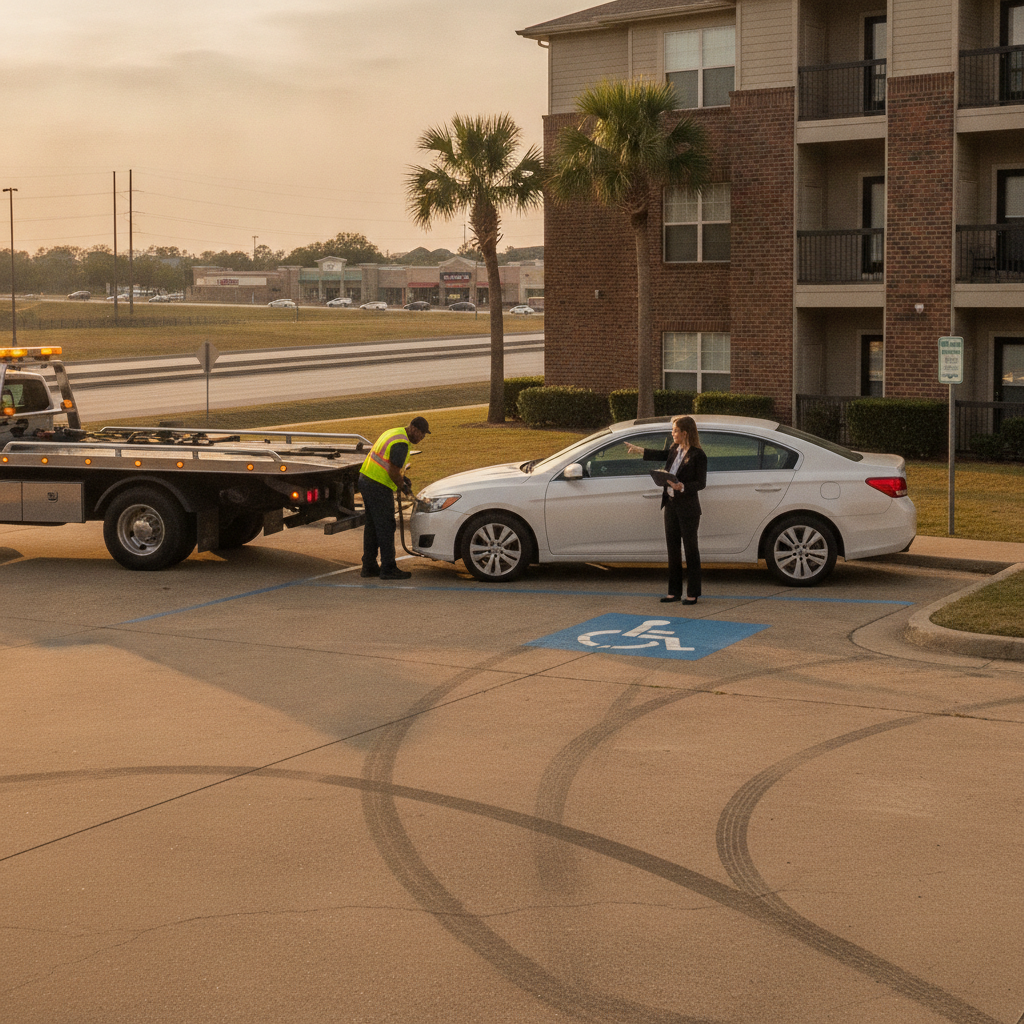
How Do Houston Towing Companies Legally Handle Vehicles Parked in Accessible (ADA) Spaces Without a Valid Placard on Private Property?
Yes, a towing company can legally remove a vehicle occupying an accessible parking space on private property in Houston without a valid disabled parking placard or license plate — but only when the property owner has satisfied specific requirements under Texas Occupations Code Chapter 2308, and only when enforcement is carried out by a TDLR-licensed operator following the correct authorization process. If either element is missing, the tow may expose you as the property owner to a wrongful tow claim, a civil complaint, or worse, an ADA-related accessibility grievance. This article walks you through exactly what is required, what most properties are getting wrong, and how to close those gaps before they become a problem.
Why Accessible Parking Enforcement Is a Legal Pressure Point Most Properties Underestimate
Accessible parking violations feel straightforward — someone parked in a blue-striped space without a placard, and you want them gone. The legal picture is more layered than that. As a private property owner or HOA board in Houston or Harris County, you are operating under two distinct compliance frameworks simultaneously. One is state towing law. The other is accessibility law. Neither one cancels out the other.
Under Texas Occupations Code §2308.255, a tow from private property requires written authorization from the property owner or an authorized representative before the vehicle is removed. That requirement applies to accessible space violations the same as it does to any other unauthorized parking. There is no shortcut because the violation seems obvious.
At the same time, the Texas Accessibility Standards — derived from the Americans with Disabilities Act and enforced through the Texas Department of Licensing and Regulation’s Architectural Barriers program — require that a minimum number of accessible spaces be properly marked, maintained, and available at all times. If your accessible spaces are routinely occupied by non-compliant vehicles and you are not enforcing them, you may face exposure on the accessibility side as well. Enforcement is not optional — it is part of maintaining a legally compliant property.
What Signage Must Be in Place Before You Can Legally Tow From an Accessible Space
Before any vehicle can be towed from an accessible space on your Houston property, your signage must meet the requirements set out in Texas Occupations Code §2308.301 and §2308.302. This is where many properties — especially older apartment communities along the FM 1960 corridor, in Pasadena, or in established neighborhoods like Spring Branch — fall short. The signs have faded. The tow company information is outdated. Or the required language about fees and the storage facility has never been updated.
Compliant signage for accessible space enforcement specifically must:
- Be posted at each accessible space or at the entrance to a clearly designated accessible parking area
- State that unauthorized vehicles will be towed at the owner’s expense
- Include the name and phone number of the towing company authorized to remove vehicles
- Meet minimum size requirements under TDLR rules so the sign is legible from a vehicle approaching the space
- Reference the vehicle storage facility where towed vehicles will be taken, so an owner can recover their vehicle without delay
A sign that simply says “Accessible Parking Only — Violators Will Be Towed” without identifying the towing company and storage location is not compliant under Chapter 2308. A tow made under that sign can be challenged. If you are unsure whether your current signage meets the standard, a property compliance review from your towing partner should be your first call — not your last.
The Placard Verification Issue: What Towing Companies Are — and Are Not — Required to Do
Here is a gap that almost no competitor towing content in the Houston market addresses: a licensed towing company is not obligated to verify whether a placard is authentic before authorizing removal, but the documentation it creates matters enormously if the tow is later disputed.
In Texas, disabled parking placards are issued by the Texas Department of Motor Vehicles. A placard hanging from a mirror does not automatically mean the vehicle is authorized to use the space — the placard must be valid (not expired), belong to the vehicle’s occupant or someone they are transporting, and in some cases be accompanied by a matching disabled person license plate. Enforcement of the actual placard law (Texas Transp. Code §681.011) is a law enforcement matter, not a towing company matter. But what your towing company is responsible for is thorough documentation: photographs of the space, the vehicle, the signage, the absence of a placard or plate, and the condition of the vehicle at the time of removal.
That documentation protects you. If a vehicle owner later claims they had a valid placard and files a wrongful tow complaint, your towing company’s photo record is your defense. A compliant operator will capture this evidence before the hook is ever attached. An operator cutting corners will not — and that gap in documentation becomes your liability as the property owner who authorized the tow.
HOA Boards and Apartment Communities: What §2308.253 Says About Your Enforcement Authority
If you manage an apartment community or serve on an HOA board in Cypress, Missouri City, or anywhere else across Harris County, you need to understand the limitation built into Texas Occupations Code §2308.253. For residential properties, authorization to tow a vehicle cannot come from a towing company employee alone — it must come from the property owner, a property manager, or an authorized representative of the property. This matters for accessible space enforcement because it means you cannot simply instruct a towing company to patrol your lot and tow from accessible spaces at their own discretion without a signed authorization structure in place.
For communities that want proactive enforcement — not just reactive tows when a manager happens to walk past a violation — this is where a virtual permit management system becomes useful. MC Towing’s parking enforcement and property solutions include iStall virtual permit management, which creates a documented, auditable system for tracking who is authorized to park where. When an accessible space shows an unregistered vehicle, the enforcement action is backed by a clear record — not a judgment call made in the moment.
Commercial Properties in Houston: Higher Scrutiny, Higher Stakes
If you own or manage a commercial property — an office park near Bellaire, a shopping center in Sugar Land, or a medical-adjacent building in Katy — accessible parking enforcement carries a higher level of legal scrutiny than it does for residential properties. The reason is straightforward: the ADA Title III applies directly to places of public accommodation, and your parking lot is considered part of that covered facility.
That does not mean you cannot tow. It means you need to document that your accessible spaces meet minimum count requirements, that they are properly marked with the International Symbol of Accessibility and the required vertical signage, and that your enforcement is consistent — applied equally, not selectively. Selective enforcement (towing from accessible spaces only when it is convenient) can itself become a source of legal exposure if challenged. A towing partner who understands compliance documentation is not a luxury in this context. It is a practical risk management tool.
For commercial property owners who want to review their current enforcement posture, parking lot towing for commercial properties in Houston should start with a signage and authorization audit — before the first tow, not after the first complaint.
Frequently Asked Questions
Can a Houston property owner tow a vehicle from an accessible space if it has a placard but the driver is clearly not disabled?
This is a law enforcement question, not a private property towing question. If a placard is visibly displayed, a private property towing company generally should not remove the vehicle solely on suspicion of placard misuse — that determination belongs to a peace officer. The correct step is to contact local law enforcement to investigate the placard’s validity. Your towing company can advise you, but should not make that call unilaterally.
Does my apartment complex in Houston need a signed towing contract before I can enforce accessible parking?
Yes. Texas Occupations Code §2308.255 requires that towing from private property be authorized in writing. A signed towing agreement with your licensed operator — one that specifically identifies the property and the types of violations subject to enforcement — is required before any vehicle can be removed under your authority.
What happens if a towed vehicle owner claims they had a valid placard and files a complaint?
If your towing company captured pre-tow photographs showing no placard was present and your signage was compliant at the time of the tow, you have a defensible record. The complaint process runs through TDLR. A licensed, compliant towing operator will maintain that documentation. An unlicensed or non-compliant operator likely will not — leaving you exposed.
How many accessible spaces does my Houston property legally need?
The required number is set by the Texas Accessibility Standards and varies based on total parking lot size and facility type. A commercial property with 25 spaces typically requires at least one accessible space. Requirements increase on a sliding scale. For properties subject to the Architectural Barriers Act, the Texas Department of Licensing and Regulation oversees compliance. Your architect, accessibility consultant, or a knowledgeable towing partner can help you identify whether your current layout meets the standard.
Can I use a virtual permit system to manage accessible space assignments for residents with disabilities?
Yes, and for apartment communities or HOAs, this can be an effective way to reserve specific accessible spaces for registered residents with valid placards while maintaining an audit trail for enforcement. A system like iStall can record authorized vehicles by space type, making it clear when a vehicle in an accessible space does not belong there — and providing documentation to support an enforcement action if a tow is authorized.
Work With a Towing Partner Who Understands Both Sides of This Compliance Problem
Accessible parking enforcement on private property sits at the intersection of Texas towing law and federal accessibility requirements. Most towing companies in the Houston area talk about enforcement. Very few have a process that actually protects you when a tow is challenged. MC Towing Inc operates as a TDLR-licensed towing company with deep familiarity with Texas Occupations Code Chapter 2308, and we work with apartment communities, HOA boards, and commercial property managers across Harris County, Fort Bend County, and beyond to build enforcement programs that hold up.
If your accessible spaces are being abused and your current enforcement posture has gaps — in signage, in authorization, or in documentation — contact MC Towing Inc for a free property compliance review. We will walk through what you have, identify what needs to change, and help you build an enforcement program that keeps your property compliant and your liability exposure where it belongs: at zero.